¡Empieza a aprender hoy!
Sé de los primeros en enterarte de nuevas oportunidades de Journalism Courses del Centro Knight.


On a day devoted to discussing how news organizations can foster community trust and the role of journalism amid growing democratic challenges around the world, speakers at the 27th International Symposium on Journalism (ISOJ) urged newsrooms to rethink what value they offer their audiences — and how they can work with those audiences to build that value.
The question of how to bridge the gap between journalists and audiences was a recurring theme on the first day of the two-day conference, held Sept. 17-18, and emerged during ISOJ’s opening session with Tom Rosenstiel, a professor at the University of Maryland’s Philip Merrill College of Journalism and author of the recently published book “The Next Journalism.”
During a conversation with Rosental Calmon Alves, founder and director of the Knight Center for Journalism in the Americas, which organizes ISOJ, Rosenstiel argued that the future of journalism depends on moving from a “journalism of attention” to a “journalism of value.”
For decades, he said, journalism built its business model around capturing audiences’ attention and selling access to those audiences to advertisers. But as the internet fragmented audiences and advertising migrated to technology platforms, that model largely broke down.
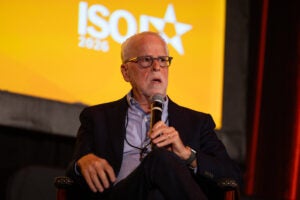
Tom Rosenstiel at the 27th International Symposium on Journalism, Sept. 17, 2026. Patricia Lim/Knight Center
Now, journalism needs to rethink not only how to make money, but what it offers audiences in the first place, Rosenstiel said. He emphasized the importance of making journalism useful to people’s lives, citing products such as The New York Times’ Wirecutter and cooking sections, which he said have become vital to his own day-to-day life.
“What people need is journalism that will help them live their lives and improve their communities,” Rosenstiel said.
Elizabeth Green, CEO and founder of Civic News Company, echoed those ideas in her keynote speech and offered a three-point plan for journalists to rebuild their business models: Be clear about the value you provide; build an economic model that supports that value; and get the right governance and capital to allow you to work with integrity.
“The problem with the wrong kind of governance and capital is that it makes itself God, when the real God here has to be the value we are providing for real, specific people,” Green said.
The idea of bridging the gap between the public and journalists continued during the panel “Rebuilding Trust: Community-Centered Journalism in an Age of Misinformation, Crisis and Uncertainty,” where speakers described ways news organizations are building value by developing lasting relationships with the communities they serve.
Jody Chong, executive director of City Bureau, a Chicago-based nonprofit newsroom, described how the organization seeks to fill information gaps through services such as guides to immigration enforcement activity in the city. The outlet also created the Documenters Network, which trains community members to cover public meetings.
“They combine the lived experience and personal networks of a community member and a neighbor, paired with the innate curiosity of a journalist and the training to produce accurate information,” Chong said.
Martina Guzmán spoke about VERDAD, an AI-powered tool she developed to detect disinformation being spread through Spanish-language radio stations in the United States. She said she hopes the technology can eventually become part of a warning system that alerts journalists to disinformation before it spreads.
Nina Weingrill, a journalist and researcher with Democratic Information Governance (D.I.G.), which seeks to improve the quality of information produced during large-scale events and crises, spoke about her recent research on the 2024 mass flooding in Rio Grande do Sul, Brazil. Journalists worked with communities across multiple platforms to communicate information during the disaster.

Madeleine Bair at ISOJ on Sept. 17, 2026. Patricia Lim/Knight Center
During spotlight talks with founders of community-driven newsrooms in the U.S. and Portugal, media leaders offered other examples of how journalists can rethink their relationships with audiences.
Catarina Carvalho, editor and founder of Mensagem de Lisboa, a hyperlocal news outlet in Portugal, said her team hosts live journalism events where community members share their personal stories onstage.
One participant was a man who married a Roma woman and had to flee with her after her parents threatened to kill them. Another shared how he became a supermodel after growing up in a slum.
“When people see that our stories are true, that we are bringing these people together on stage, they show us that they trust us, and it brings people together,” Carvalho said.
Madeleine Bair, founder and co-executive director of El Tímpano, a media organization serving Latino and Indigenous Mayan immigrants in the San Francisco Bay Area, said the outlet regularly brings its journalism into community spaces rather than expecting people to seek out its stories.
At the Bay Area’s largest Día de los Muertos festival, for instance, El Tímpano created a community altar where people could share memories of loved ones who had died.
“Rather than feeling helpless, afraid or victimized, community members share with us that these programs leave them feeling empowered, connected and part of a larger community,” Bair said.
In another panel, Adam Ganucheau, executive editor and chief content officer of Deep South Today, said his outlet builds community trust through accountability reporting. He highlighted a recent story on lead concentrations in playgrounds and the outlet’s efforts to connect with local residents through direct mail and in-person events.
The same emphasis on understanding audiences emerged in a discussion about coverage of the upcoming U.S. midterm elections. Anna Johnson, Washington bureau chief for The Associated Press, said journalists need to focus on understanding voters’ concerns rather than centering coverage solely on candidates or political figures.
“Voters are the center of our coverage, not candidates, not the president,” Johnson said. “And while the presidency is certainly part of that ecosystem, … we're talking to voters to understand better what they care about, what really matters to them.”
The shift toward audience-centered journalism also extends beyond traditional newsrooms. Independent and creator journalists at ISOJ emphasized the growing role of the creator economy and the ways it has changed how some people consume news.
Liz Kelly Nelson, founder of Project C, an organization that supports independent creator journalists, said many news consumers turned away from traditional media during the COVID-19 pandemic and shifted their focus to independent creators.
“It wasn't apathy,” Kelly Nelson said. “It was feeling that institutional journalism was too elite, too complex, biased, depressing, irrelevant; all things that creators are the opposite of.”
Through Project C, Kelly Nelson helps independent journalists build sustainable careers. One creator supported by the organization is Becky Bullard, founder of Democrasexy, which aims to demystify Texas politics through Instagram videos, live events and other formats.
“Call her whatever you want,” Kelly Nelson said. “Her work is an act of journalism.”
The second day of this year’s ISOJ will focus on AI, innovation and the future of news, with panels featuring journalists and industry leaders including Jonathan Greenberger, Global Editor-in-Chief of POLITICO; Allison Murphy, COO of Axios; Sisi Wei, chief impact officer at CalMatters and The Markup; and Zach Seward, editorial director of A.I. initiatives at The New York Times.
More than 400 people attended ISOJ in person at the University of Texas at Austin, while almost 400 participated virtually.